What Is the Sunny 16 Guide?
When you purchase through links on our site, we may earn an affiliate commission at no additional cost to you. If you want to find out how this works: [Read More Here]
Sunny 16 Guide!
When photography took off like a rocket cameras were strictly manual. No TTL, not even a selenium meter built-in. So, a rule of thumb (now referred to as the “Sunny 16 Rule” that allowed photographers to estimate correct (or mostly correct!) exposure.
Why do I say “mostly?” Well, it’s not a precision method – it’s a workable approximation. Even back then films had a small degree of wiggle room and nowadays most modern films have a very good degree of latitude.
How Does It Work?
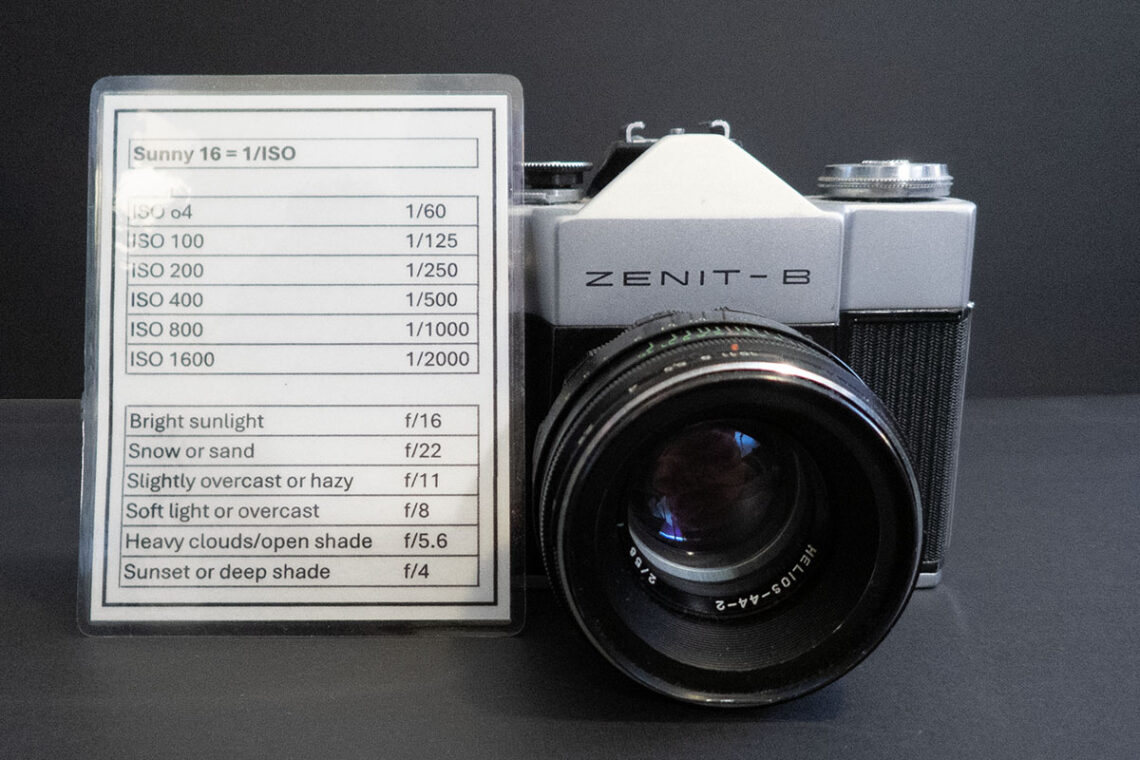
It’s actually very simple. For direct bright sunlight (Hence “Sunny 16”) all you have to do is set your shutter speed to the reciprocal of your ISO and then set your aperture to f/16.
So, effectively it is 1/ISO.
Now, most vintage cameras have a very discrete selection of shutter speeds available unlike modern cameras such as 1s, 1/30, 1/60, 1/125, 1/250, 1/500. Some of the 1960’s pro cameras and later consumer cameras added 1/1000 and 1/2000 into the equation.
In other words, if the film speed is:
ISO 64 – 1/60 sec
ISO 100 – 1/125 sec
ISO 200 – 1/250 sec
ISO 400 – 1/500 sec
ISO 800 – 1/1000 sec
ISO 1600 – 1/2000 sec
It’s not perfect but it will work and today’s films are very forgiving – particularly black and white stock – but even color will come out acceptably.
Apart from Sunny 16 you can set the aperture according to:
Snow or sand – f/22
Slightly overcast or hazy – f/11
Soft light or overcast – f/8
Heavy clouds or open shade – f/5.6
Sunset or deep shade – f/4
So Why Use It Today?
Many vintage cameras do not have a meter at all and many have a meter that either does not work or is inaccurate. Yes, you can carry a light meter and there are literally hundreds available at any one time, Most of those, however, will be inaccurate because they are selenium based and selenium meters degrade with time.
It is possible to strike it lucky. I have a Petri 7S and a Yashica Minister D that both have functional and accurate (within 1/3 stop) selenium meters.
You can use this rule even with very modern cameras. Why do that? Going fully manual and using your brain rather than a built-in meter will help you learn the exposure triangle. Of course it also means you can set the reciprocal speed exactly.
Sunny 16 Is Worth Knowing
It’s a very easy rule to remember and for those of you who like to use vintage cameras it’s a backstop against being out and about and your vintage camera’s meter fails. Does that happen often? No, it doesn’t but it does and can happen. It’s happened to me when a Pentax Spotmatic meter stopped working.
And, of course most cameras in the sixties onwards used a battery for the meter and that can easily fail. If your shutter also depends on the battery you are screwed unless your camera has a mechanical speed setting that you can continue shooting with.
I doubt you will use it often but it’s such a simple rule so why not learn it?

You May Also Like

Nikon Joins Competitors in Raising U.S. Prices Due to Tariffs

OM System Tough TG-7 – A Worthy Upgrade from the TG-6?